Automate your Bitcoin portfolio
without giving up custody.
TIYlab runs three complementary strategies directly on your exchange. Your assets never leave your account and the API key must disable withdrawals. The system prioritises discipline and risk control through bull, bear and transition phases, without promising returns.
Past performance does not guarantee future results.
TIYlab is a portfolio automation software tool. Backtest results are available in the Documentation section. Past performance does not guarantee future results.
Real results before simulations.
The track record is powered by real system data since April 2026 and compared with Bitcoin over the same period.
Why no trade can be the right trade
A quiet bot is not necessarily inactive: it can monitor the market and protect its rules while waiting for valid conditions.
You keep control of your funds.
TIYlab never receives your crypto-assets. The service connects to your exchange with a trade-only API key, without withdrawal permission.
No deposit to TIYlab
Your funds stay on your own exchange account, not on a third-party platform.
Withdrawals impossible
The API guides explicitly require disabling every withdrawal permission.
Revocable anytime
You can revoke API access directly from your exchange if you decide to stop.
Start in three steps.
Onboarding is guided: choose your exchange, create a no-withdrawal API key, then activate the license in the Telegram bot.
Choose the exchange
Binance, Bybit, KuCoin, OKX, Bitget, Gate, MEXC or HTX.
Activate in Telegram
Enter your license, set your capital, then the bots start.
Inside the TIYlab Telegram experience
Onboarding, status, equity, daily diagnostics and important events: see how TIYlab explains the portfolio.
Bear protection mode active.
Macro Bot is in cash. No active long position. Discipline, not panic.
—
—
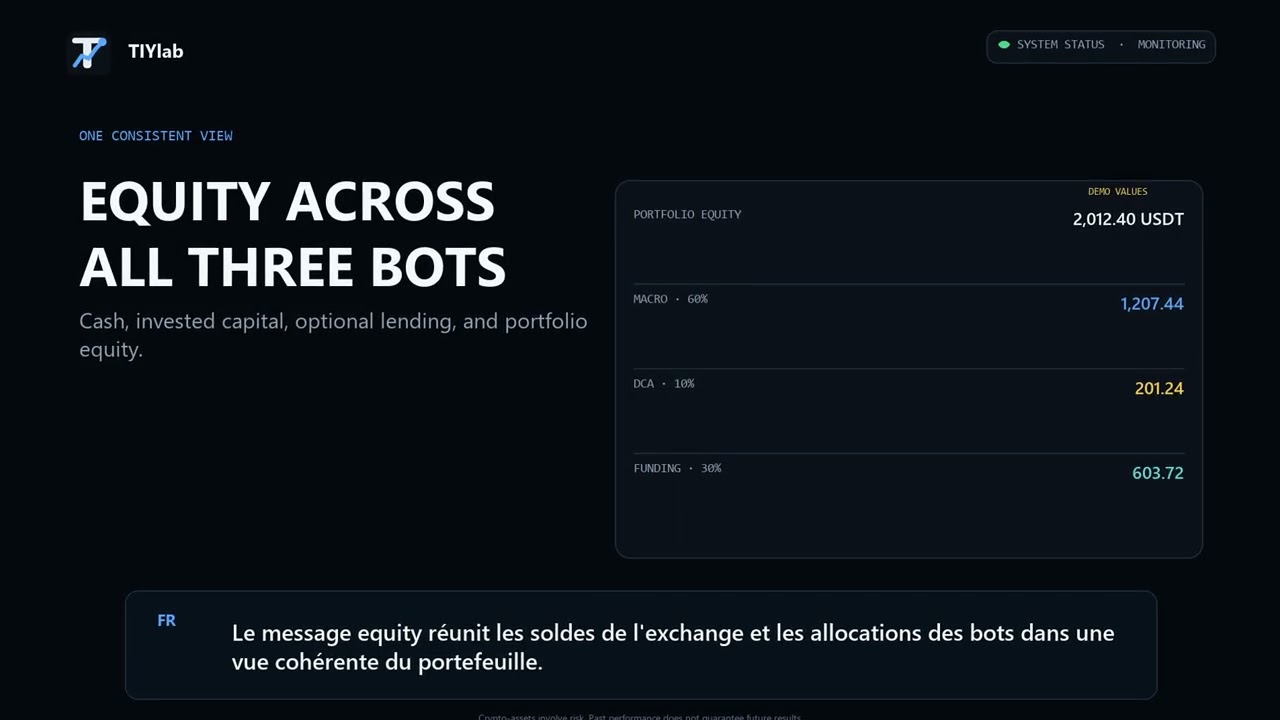
60/10/30
Macro / DCA / Funding
—
—
Sharpe 0.73
+646% · MaxDD -53.4%
Past performance does not guarantee future results. This is not investment advice.
Three bots. One mission.
Each bot owns a piece of the strategy. Together, they adapt to any market.
Macro Bot
60%Reads macro regimes — reinforced bull entries, filtered bear rally shorts, de-risking at extremes.
DCA Bot
10%Steady Bitcoin accumulation through disciplined buys. Keeps the portfolio active.
Funding Bot
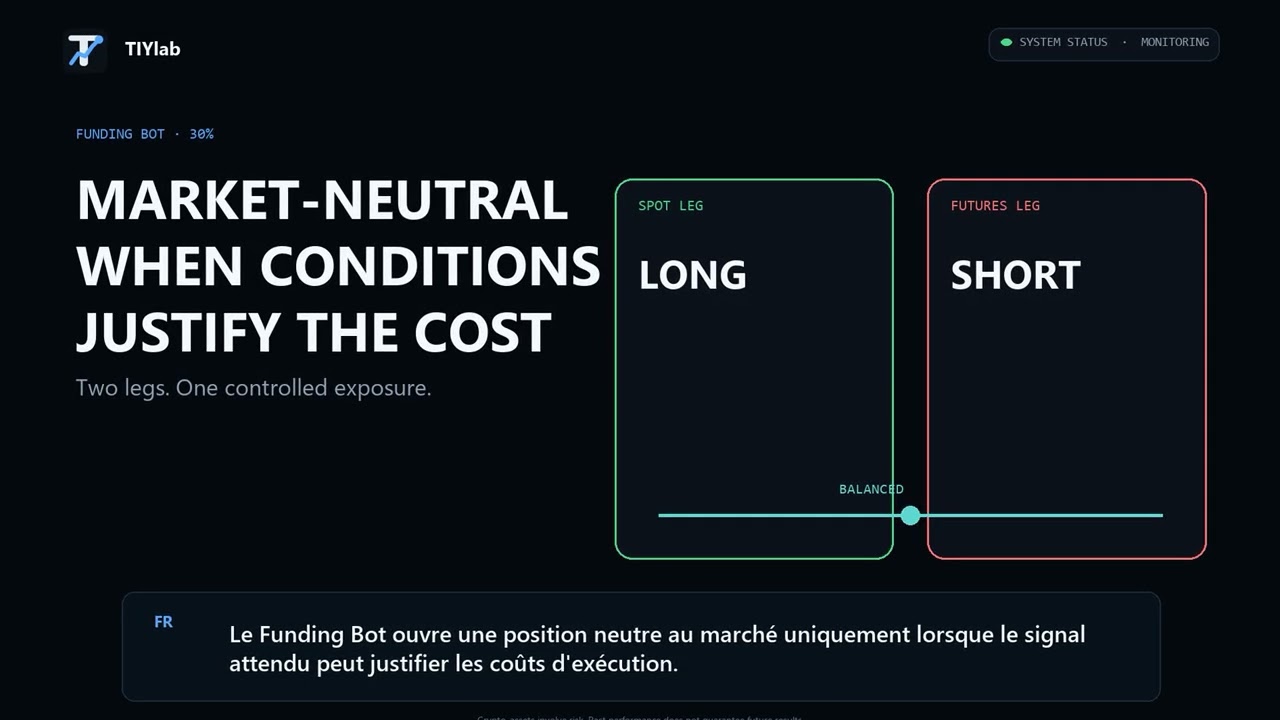
30%Market-neutral carry strategy. Generates returns whether BTC goes up, down, or sideways.
Built for BTC holders.
A tool to delegate discipline, not control.
✓ Ideal profile
Medium/long-term BTC holder with $2,000 minimum on an exchange. Familiar with APIs but doesn't want to actively manage positions. Looking for disciplined, automated portfolio management. You want to automate a structured BTC strategy. You accept a fixed, non-customizable allocation. You prefer keeping funds on your exchange. You understand that backtests do not guarantee the future.
✗ May not be the right fit
Complete beginner (too much support needed), capital < $2,000, looking for quick 10x gains, or professional who codes their own tools. You are looking for scalping or aggressive leverage. You want to modify bot parameters. You plan to trade manually on the same account. You expect a promise of quick returns.
You stay in control.
What you get with TIYlab: the goal is not to add another interface to watch. TIYlab automates decisions, notifies you, and keeps your funds on your exchange.
3 coordinated BTC bots
Macro, DCA and Funding work together with the fixed 60/10/30 allocation.
8 exchanges
Binance · Bybit · KuCoin · OKX · Bitget · Gate · MEXC · HTX. Each exchange has dedicated API documentation to reduce setup mistakes.
Non-custodial
No deposit to TIYlab. Your funds stay on your exchange. We can't withdraw. Ever. Trade-only API key, revocable on the exchange side.
Telegram-first
Monitor, configure and control everything from your phone. Activation, monitoring, pause and notifications go through the TIYlab Telegram bot.
Optional Macro lending
Enabled via Telegram on Binance, Bybit, KuCoin and OKX only. It applies to idle Macro cash; no withdrawal permission is requested.
Daily monitoring
Daily email report (10:00 UTC via /setemail). Trades & regimes on @TIYlabSignals. Automatic Telegram summary. Public live tracker and visible operating signals.
Built-in risk management
Reinforced bull entry, conditional long protection, filtered rally shorts and overextension de-risking.
Open methodology
0.02% slippage, 0.1% fees, no look-ahead bias. All published.
Not all solutions are created equal.
Alternatives exist. Here's why they fall short.
Exchange built-in bots
Binance Grid, Bybit DCA… The exchange profits from your fees, not your performance. Structural conflict of interest. Basic strategies with no bear market protection — they'll never play against themselves.
Open-source bots
Freqtrade, Jesse, Hummingbot… Require a VPS, constant maintenance, and strong technical skills. No support. A bug at 3 AM? That's your problem. Free has a hidden cost.
TIYlab
Turnkey. Macro strategy tested over 8 years. Active bear market protection. Zero technical skills required. Human support. Your funds stay on your exchange. We only win if you stay.
Your keys, our responsibility.
AES-256-GCM
Your API keys are encrypted at rest using AES-256-GCM. Never stored in plain text, never displayed, never logged. The TIYlab team cannot access your keys.
Trade-only permission
Your API keys are configured without withdrawal permission. Even in case of compromise, no funds can be withdrawn.
IP whitelist
Restrict your keys to our server IP address. Unusable from any other location.
EU infrastructure
Hetzner server in Germany. Data hosted in the European Union. GDPR compliant.
Our scope, fully transparent.
✓ What we do
Provide a SaaS software license. Execute orders via the client's API keys. Send reports and alerts. Encrypt data at rest.
✗ What we don't do
Hold or custody funds. Provide financial advice. Guarantee performance. Make withdrawals. Manage portfolios on a discretionary basis.
◈ What you control
Your exchange account. Your API keys (creation, deletion). Your capital. The decision to continue or stop at any time via Telegram.
Join the beta.
5 free 12-month licenses. We need your feedback to improve the service.
Free 12-month license
Send us an email at the address below — mention your exchange and approximate capital.
Reserved for the first 5.
Their experience with TIYlab
TIYlab's bots offer effective protection against compulsive entries and exits. The administrator replies clearly and quickly, helping prevent panic and reckless Bitcoin buys.
The bots are cautious and serious. Crypto has entered a more serious phase, and TIYlab avoids reckless decisions.
The market has become unstable and can ruin us quickly if we act without thinking. The era of dreamers is over. TIYlab manages investments like a responsible family provider.